Re-imagined
My Imagined Kindergarten Classroom
1. Five images (you can take them or they can come from the Internet [provide proper credit]). These images should reflect, in some way, what you imagine your classroom will look like once you are a teacher. Please annotate your images by providing a description of the image and how it relates to your future classroom.
 |
| https://www.buzzfeed.com/weareteachers/21-creative-and-clever-reading-spaces-for-the-clas-h0xt?utm_term=.ufZLN6809#.ewYLo9O3l |
 |
| http://eberhartsexplorers.blogspot.com/2013/08/classroom-digs.html |
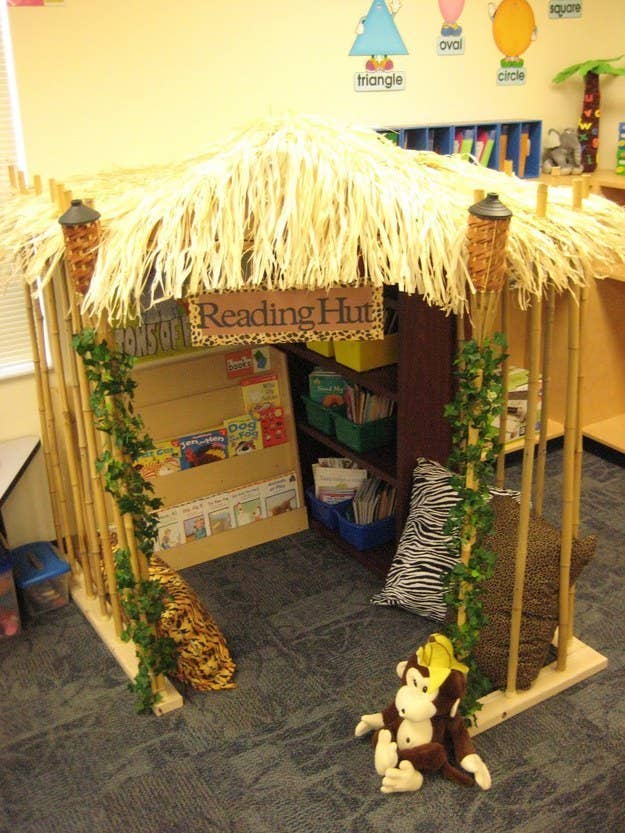
I will also make sure that I include many different books that show diversity. I want my books to include examples of as many different backgrounds- culturally, racially, ethnically, familial, and otherwise - as I can. I want my students to be able to learn about diversity, see it normal, and recognize themselves in the books I have available to them. I want my students to learn not to be prejudiced. Providing books about diversity or that include diversity is a way to teach social justice and fight oppression.
 |
| http://tickledpinkmandy.blogspot.com/2011/08/back-to-school.html |
I will keep my desks arranged like this to facilitate conversations and students taking an active role in the learning process. I will assign students to seats at the beginning of the year according to their prior knowledge in subjects, making sure that students are spread throughout the room to help one another learn. Throughout the year, I will change their groups at the tables so they have as many experiences to work with a diverse population of peers as possible. I will need to make sure that the desks have enough room for a wheelchair.
 |
| https://i.pinimg.com/originals/ec/25/01/ec2501897f322eb882015c7b60a164fb.jpg |
I would like to keep floor time because I think it is efficient and fun. I will have the students sit in alphabetical order. If a student has a disability, I will make sure that there is a place for them where they can comfortable maneuver to. I will also ask them what what they would like to do/where they would like to be in order to make sure that they are as comfortable and happy as possible.
 |
| http://sharingkindergarten.com/working-on-room-so-grab-some-tips/ |
I will have a bulletin board to display each student's most recent work. In keeping with the jungle theme, each monkey represents a student.
Some students may not like having their work displayed, or may want a certain assignment displayed instead of another assignment. Because of this, I will let my students have up to one assignment displayed at a time. They can choose what they want to have displayed and for how long. If a student does not want to display their work, I will not force them to. Additionally, I would remove the monkeys from the display board and instead have something that works with the theme my students help choose together.
 |
| https://i.pinimg.com/originals/5e/e6/a8/5ee6a81de5b5890ccbe5a003c8ea01ab.jpg |
I would like to keep my organization system, but I would need to make sure I have labels in multiple languages for emerging bilinguals. In this way, their first language will be reinforced and they will not be as confused or discouraged trying to find something. I would like to have maybe a longer shelf rather than a tall shelf, in order for students with disabilities to be able to easily reach the containers.
2. Imagine the surrounding in your classroom. What does the room look like? What resources are available for students? How are the resources used during the lesson?
The room looks colorful and exciting while still being organized. The decorations will be more subtle than overwhelming, because they are not the main focus - learning is. The students' resources include me, books, signs around the classroom, class materials, handouts, and each other. For each lesson, I will have a table with resources specific to the task available to the students at any time. If they need further help, I encourage them to raise their hands or come to my desk so I can help them.
I would also like to put up a sign that says my classroom is a safe space for LGBTQ+ students. This will help them and their families feel more comfortable. Items in the classroom should be spaced out enough to allow students with disabilities to easily maneuver around the room. I want to have labels in multiple languages to help my emerging bilingual students to understand their resources and activities. I would also like to have pictures around the classroom that showcase diversity, especially the diversity present in my classroom. I found this idea from this website: http://www.teachingforchange.org/anti-bias-education-articles, which I think is a really good resource for me to have. I would also like to have resources available for diverse students. For example, a basket full of red pieces of paper for students who feel uncomfortable or offended. Students can take a piece of paper at any time, and this will let me know to speak with them and work with them to make the classroom a more equitable environment.
Many of my students might come from backgrounds where hand-raising is culturally normal, but many of them might not as well. Because of this I will allow students to ask for help in other ways. I think it would be fun to have a classroom lesson and discussion where we decide as a class how students will communicate a need or desire for help instead of just raising their hands or coming to find me.
3. Describe the students in your classroom. What are their backgrounds? What are their interests? What are they doing during the lesson?
Because I am teaching Kindergarten, the students will come from many different backgrounds and have differing levels of experience and therefore ability in certain tasks. While I would hope that they are all interested in learning what I have to teach them, I realize that not all of them are. They have many different interests, from animals to books to people to art and beyond. During the lesson, the students are working hard but also having an enjoyable time. They help each other and ask questions when they have them, but listen when it is time to do so. I want their learning to be a collaborative, social experience.
Students will work with others of various backgrounds. I would like to encourage students to get to know peers who come from different cultural, ethnic, and racial backgrounds. I would also like students with disabilities to be included in conversations and groups. I really would like their learning to be a social experience. I realize now that my students will come from more diverse backgrounds and experiences than I had originally thought, but each student will be welcomed regardless of their backgrounds, sexual orientations, familial situations, or gender identities.
4. Describe your classroom policies. What are your classroom rules? What is your discipline plan? What are your homework policies?
My classroom rules:
- Listen the first time
- Always be kind to others
- If you have a question for the teacher, raise your hand
- Share the materials
- Participate in every activity
I would add a very important rule to this list: Respect. It is partially included in being kind to others, but I think students need to learn how to respect differences and each other more explicitly. I would also remove the rule about raising their hands with questions, because of the potential cultural differences I explained earlier. I would also modify the rule about participating in every activity. Students might be unable to participate in activities due to religious or cultural beliefs and practices. Instead, I would like them to participate in every activity that they can. I would like to communicate with parents about appropriate activities for their children instead of forcing something upon the student.
My discipline plan:
- For minor classroom disruptions, I will start with a small warning - reminding the students of the rules. If the disruptions continue, I will have the student come talk to me briefly at the beginning of a classroom activity.
- For larger problems between students, I will have both students talk to me during a non-essential activity, but they will not be able to participate with the other students. (For example, they will sit by my desk reading a book or completing a quiet assignment while the other students have structured play time.) I will also use this discipline for continued disruptions. These situations may merit a note sent to parents.
- In extreme situations, I will involve parents and possibly school administration.
If students have larger discipline problems, I would like to speak with them about it before taking action. Students may be having a hard time following rules or be in conflict with another student for reasons related to their backgrounds/cultures. These are important for me to acknowledge and work out instead of punishing students for their beliefs or practices.
The wording of my discipline plan should also be changed - "guardian(s)" instead of "parents" would be more appropriate, to include students who might be living with someone who is not a parent, in a single-parent home, or who have multiple adults interested in their education.
This plan is more of a guideline, but I will make sure I am explicitly open to individual adaptation according to familial, student, or classroom needs. This will allow students with disabilities to have a personalized plan for discipline, and will also allow me to adapt my discipline according to the situation.
My homework policies:
- I do not think that students in Kindergarten should have large amounts of homework. Most homework assignments will consist of finishing work not completed in class, to be due the next day. I will send a weekly list of sight words home with students each Monday. The next Monday, they will need to return it signed by parents that they practiced for 10 minutes every day. If they forget to bring it, the student has until Wednesday to bring it in.
I also will assign time for reading practice and writing. I forgot to include those when I first completed this assignment. Additionally, I will make sure I have supplies for all of the students. Students will be allowed to take books of their choice from the classroom library, and I will include writing utensils in their homework packet. The place for a signature saying that the student has completed their assignment will be changed from "parents" to "guardian(s)" with enough room available for multiple people to sign if they wish.
Homework assignments can be adjusted according to student ability. I will adjust automatically based on any IEPs and work with students and guardian(s) for any other adjustments needed.
5. Describe a typical lesson you will teach in your classroom. What will you teach? What is the topic? Why did you choose this topic? How will you teach it? What is the main thing you want students to learn during this lesson?
For this lesson, I will teach how to read the letters of the alphabet. I chose this topic because knowing how to read individual letters is one of the first steps in learning how to read. Some students may already know these, but it is foundational. I cannot risk any student not knowing this moving forward. I will teach it through first using more of a lecture format followed by a game. The main thing that I want students to learn is the basic phonics of the alphabet.
I failed to consider emerging bilingual students when I thought of this lesson. Before teaching the students phonics in English, I should talk about the concept of language. I would need to help students understand the concept of using a language at school and that it doesn't make this language better than any other language. I would like to include examples of other alphabets and have students who know the alphabet of another language share it with the class before we work on the English alphabet. I should focus on helping emerging bilinguals translanguage rather than forcing them to only use English.
6. Imagine your work as a teacher during this lesson. What are you doing during the lesson?
During this lesson, I will first be at the front of the classroom teaching each letter of the alphabet. When it is time for the students to play their game, I will move throughout the classroom helping them as needed.
I would mainly keep my work the same during this section, with most of the changes coming in my teaching methods. I would like to invite more student participation when I am teaching them to read the letters. I can give them an example of words that have certain letters in them and then ask them to give me examples as well - this will help the students connect letters to words from their personal lives and cultures.
7. Imagine your students again, what are they doing during the lesson?
During the beginning part of this lesson, the students will be sitting on the mat, repeating sounds back to me. Later, they will be sitting at their desks working in pairs to sound out letters on flash cards.
Students should not be only repeating sounds back to me - that is what Paulo Freire called banking education. Rather, I will model the sounds and allow them to explore them more, like with understanding how to use them in words.
8. Imagine how you will assess your students' learning and achievement. How will you know they have learned?
I do not expect students to learn this all in one setting, so I will repeat the activity periodically. To assess their learning, I will give the class an assignment to do at a later date and then call each student individually to show me how well they do at the flash card phonics.
For other lessons, I may use similar techniques, or assess their learning through their writing or artwork about a particular subject.
I like the idea of having more informal assessments that will not put as much stress on the student. I would like to add that I give students multiple chances to pass something like phonics off to me and give personalized help if they need it. This will provide extra help for students who come from maybe more disadvantaged backgrounds in a school built for the more privileged white, middle class students.
Explanation:
Many of the changes I made were because I simply wasn't considering how diverse my classroom will really be and how to best teach in those situations. I know that what I have re-imagined is not perfect, but it is hopefully a step in the right direction. I want all of my students to have the best chance for success in the classroom and in life. I also want them to learn how to work with each other and respect diversity. A lot of the reason why I set my classroom up the way I did was to have the students interact. This will allow them to become more familiar with students from an array of backgrounds and realize that diversity is not only good, but helpful. I want them to think of each other as equals. I also want to provide enough support to marginalized students to make my classroom equitable.

No comments:
Post a Comment