1. Five images (you can take them or they can come from the Internet [provide proper credit]). These images should reflect, in some way, what you imagine your classroom will look like once you are a teacher. Please annotate your images by providing a description of the image and how it relates to your future classroom.
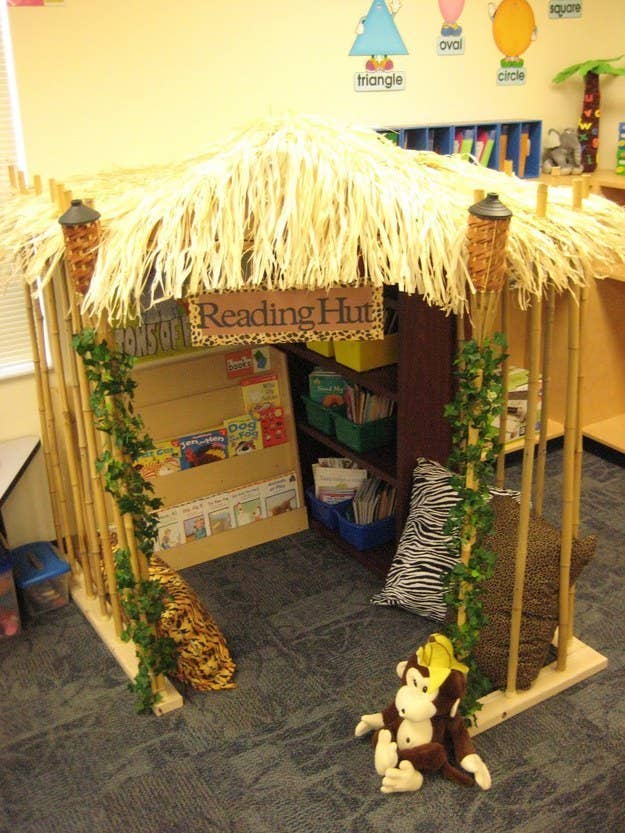 |
| https://www.buzzfeed.com/weareteachers/21-creative-and-clever-reading-spaces-for-the-clas-h0xt?utm_term=.ufZLN6809#.ewYLo9O3l |
 |
| http://tickledpinkmandy.blogspot.com/2011/08/back-to-school.html |
 |
| https://i.pinimg.com/originals/ec/25/01/ec2501897f322eb882015c7b60a164fb.jpg |
 |
| http://sharingkindergarten.com/working-on-room-so-grab-some-tips/ |
I will have a bulletin board to display each student's most recent work. In keeping with the jungle theme, each monkey represents a student.
 |
| https://i.pinimg.com/originals/5e/e6/a8/5ee6a81de5b5890ccbe5a003c8ea01ab.jpg |
2. Imagine the surrounding in your classroom. What does the room look like? What resources are available for students? How are the resources used during the lesson?
The room looks colorful and exciting while still be organized. The decorations will be more subtle than overwhelming, because they are not the main focus - learning is. The students' resources include me, books, signs around the classroom, class materials, handouts, and each other. For each lesson, I will have a table with resources specific to the task available to the students at any time. If they need further help, I encourage them to raise their hands or come to my desk so I can help them.
3. Describe the students in your classroom. What are their backgrounds? What are their interests? What are they doing during the lesson?
Because I am teaching Kindergarten, the students will come from many different backgrounds and have differing levels of experience and therefore ability in certain tasks. While I would hope that they are all interested in learning what I have to teach them, I realize that not all of them are. They have many different interests, from animals to books to people to art and beyond. During the lesson, the students are working hard but also having an enjoyable time. They help each other and ask questions when they have them, but listen when it is time to do so. I want their learning to be a collaborative, social experience.
4. Describe your classroom policies. What are your classroom rules? What is your discipline plan? What are your homework policies?
My classroom rules:
- Listen the first time
- Always be kind to others
- If you have a question for the teacher, raise your hand
- Share the materials
- Participate in every activity
My discipline plan:
- For minor classroom disruptions, I will start with a small warning - reminding the students of the rules. If the disruptions continue, I will have the student come talk to me briefly at the beginning of a classroom activity.
- For larger problems between students, I will have both students talk to me during a non-essential activity, but they will not be able to participate with the other students. (For example, they will sit by my desk reading a book or completing a quiet assignment while the other students have structured play time.) I will also use this discipline for continued disruptions. These situations may merit a note sent to parents.
- In extreme situations, I will involve parents and possibly school administration.
My homework policies:
- I do not think that students in Kindergarten should have large amounts of homework. Most homework assignments will consist of finishing work not completed in class, to be due the next day. I will send a weekly list of sight words home with students each Monday. The next Monday, they will need to return it signed by parents that they practiced for 10 minutes every day. If they forget to bring it, the student has until Wednesday to bring it in.
5. Describe a typical lesson you will teach in your classroom. What will you teach? What is the topic? Why did you choose this topic? How will you teach it? What is the main thing you want students to learn during this lesson?
For this lesson, I will teach how to read the letters of the alphabet. I chose this topic because knowing how to read individual letters is one of the first steps in learning how to read. Some students may already know these, but it is foundational. I cannot risk any student not knowing this moving forward. I will teach it through first using more of a lecture format followed by a game. The main thing that I want students to learn is the basic phonetics of the alphabet.
6. Imagine your work as a teacher during this lesson. What are you doing during the lesson?
During this lesson, I will first be at the front of the classroom teaching each letter of the alphabet. When it is time for the students to play their game, I will move throughout the classroom helping them as needed.
7. Imagine your students again, what are they doing during the lesson?
During the beginning part of this lesson, the students will be sitting on the mat, repeating sounds back to me. Later, they will be sitting at their desks working in pairs to sound out letters on flash cards.
8. Imagine how you will assess your students' learning and achievement. How will you know they have learned?
I do not expect students to learn this all in one setting, so I will repeat the activity periodically. To assess their learning, I will give the class an assignment to do at a later date and then call each student individually to show me how well they do at the flash card phonetics.
For other lessons, I may use similar techniques, or assess their learning through their writing or artwork about a particular subject.

No comments:
Post a Comment