Over the course of this semester, my worldview has consistently been challenged. I have had cause for a lot of introspection, as well as the kind of critical thinking which Paulo Freire advocated for throughout the course of his work. Taking a multicultural education course was very hard for me, but also opened my eyes to a lot of different things. I had not really thought about the world through a social justice perspective before learning about the inequities, inequalities, and oppression that really are present in so many areas of life and society.
Looking back upon the semester, I realized that I have grown more than I thought I had. For example, I wrote the following in my first reading reflection: "The
journal article 'Equity Pedagogy: An Essential Component of Multicultural
Education'....states that we
need to teach and allow children to advocate for social change and that we need
to treat groups differently in order to help minority students gain equal
status. This challenges my views about social change and also how to create
equality. I have never believed that we should treat a minority group with more
attention than the majority in order to create equality, and in order to teach
in this manner, I would need to change that view. (Cherry, 1995)" When I started, I did not think that we should teach students with equity instead of equality. Now, that perspective sounds so ignorant to me. Since I wrote that reading reflection, I have realized how valuable a social justice form of teaching can be. For example, I learned about culturally inclusive and culturally responsive pedagogy, and saw examples in my book club book Holler if You Hear Me by Gregory Michie. I praised his teaching style in my book review portfolio, and I really do think that he had an amazing approach to teaching marginalized students. Before taking this class, I think I would have been much more uncomfortable with the ideas he was bringing into the classroom, and I never would have appreciated culturally responsive pedagogy and social justice education for what it is.
During class, I sometimes took notes on questions people asked or things that they said. I think that these demonstrate my growth in having a willingness to question my own biases. During our discussion on Teaching Social Justice, I wrote: "Do I want to improve the world or stay in the safety of not having people question what I'm teaching or doing?" I don't remember who said that, but I think it's a really good question for me to ask myself. I still struggle somewhat with the concept of promoting social justice and equity, because I am a very reserved person who has grown up in a very conservative home and area. But I think this relates to one of Dr. Draper's Teaching Values and Beliefs - charity. If I truly have charity for people who are different from me, then I won't be afraid to teach in a way that allows them to flourish and learn. I decided to become an elementary school teacher because I value children and learning, so I need to show that in my teaching. This relates to two more quotes I wrote down during class. The first is from Dr. Draper. She said, "I'm not going to be the teacher protecting kids from the world, I'm going to be the teacher who prepares kids for the world." (That was during the lesson on Language and Culture.) The next, Jaquelyn said during the lesson on Class and Poverty. She said, "Stop being a teacher for me and start being a teacher for my students." I think that these both illustrate a very needed change in perspective. For a long time, I thought I was going to be a teacher because it's what I enjoy, and what I think will work well with my life goals, and I want to teach what I value in learning to my students. But I have realized that it's not at all about me. I am not going to single-handedly change the world. I am not the important person in this choice of profession. Teaching is all about serving the students who I am blessed to come into contact with. These students will all have unique backgrounds, dreams, and desires, and I didn't realize to what extend that would be true before we talked about it in class. It will be my job to facilitate their learning in a way that they can relate to and understand. Children spend a lot of time in school, and I need to use classroom dynamics to teach them how to approach the world outside of school - with kindness, love, and respect. I need to structure my classroom in a way that allows students to learn about the world and that includes and responds to diversity. I realized that when I was doing my (Re)Imagined Portfolio assignment. I want my students to see diversity as something to be valued that is normal rather than as something to be afraid of.
Something that I realized during the course of this semester is that I need to value and respect diversity myself. I learned this by reading things such as the "Mojado Like Me" article from The Personal Experience of Classification Schemes;Testimonios de Imigrantes;More Words for the Poor? Problematizing the "Language Gap"; and From Remedial to Gifted: Effects of Culturally Centered Pedagogy. These articles helped me identify my own biases and prejudices. For example, while reading the "Mojado Like Me" article, I realized that I do have racial biases and that in some ways I have been a passive racist. This article talks about how it only took a change of clothes for a middle-class Hispanic man to be treated as inferior. I have an aunt from Peru, so my cousins are Latino, and my next door neighbors are also Latino. Reading this article made me uncomfortable because I realized that I make the same assumptions about people of other races/ethnicities as the privileged white people in the article. While this makes me extremely uncomfortable, knowing it about myself has also helped me. Now that I can recognize prejudice in myself, I can also move forward in a way that helps me fight racism, both in myself and in society. Knowing that these things exist and being able to talk about them like we did in class is the first step towards a more just, equal, and equitable society. I had similar thoughts and feelings while reading Testimonios de Imigrantes, in which some students who speak Spanish as a first language are discriminated against in school because the counselors, administrators, and teachers do not believe that they can succeed. I realized that I sometimes make the same assumptions about people who speak English as a second language, just because they don't fit in to my culture. That same concept came up in More Words for the Poor? Problematizing the "Language Gap" and From Remedial to Gifted: Effects of Culturally Centered Pedagogy. Being able to think critically about my own beliefs and about society has helped me call myself out on discriminatory, oppressive thoughts and behavior. I have realized that a deficit theory perspective is so harmful to students, families, and entire cultures. I need to continuously fight that in myself until I reach a point where I am more charitable and kind.
One thing that really broadened my perspective and challenged my viewpoints was learning about gender and sexual orientation. I have always had very definite views of right and wrong, especially in regards to these more controversial topics. While I still believe in an absolute standard of truth, learning about these topics has helped me realize that not everyone else has the same opinions, and that's okay. Regardless of my own viewpoints, I need to have charity and respect for everyone, and that includes not demeaning their lifestyle. I liked what Dr. Draper said in class. She said that a good response in situations where a loved one might come out to us is to say, "I don't understand, but let me walk this path with you. I don't understand this, so I will learn and I will support and love you." Another thing that challenged me was the video we watched called "Voices of GLBT Youth". I realized that hearing the experiences of these students made me uncomfortable, but that it was because I do not understand them and had not taken the time to try, not because they are evil people trying to do a bad thing. The adjusting, acceptance, and love need to come from my side, not theirs. I also appreciated that we were able to have a panel with a couple of students who are not cis-gender. Hearing their perspectives and experiences really opened my eyes to how much I don't know and what my students will need from me. My job is not to pass judgment or to condemn lifestyle choices, especially in the classroom. My personal opinions do not have a place in the classroom, and I should work on them on my own so that I can be the most charitable and respectful as I can be.
A few other things that broadened my perspective were my portfolio assignment experiences. When I completed the assignment on Personal Cultural Artifacts, I realized that I do have a culture. That sounds like it should have been obvious, but belonging to the privileged, white middle-class suburban culture that I do, I had not taken the time to realize it. Completing that portfolio assignment really opened my eyes to my privilege and the way that I interact with the world around me. It was helpful to see where my perspectives come from so I can evaluate them and consider other viewpoints as equally valid, and possibly better for society and individuals in some cases. Experiencing something outside of my normal culture by being the "other" helped me realize a little bit of what minoritized students and individuals might feel. In my experience, those around me were extremely helpful in integrating me into their culture and explaining what I should do. A lot of people don't have that help and support, especially when they come from a background that has been marginalized. I realized this a little bit more as I completed my "Investigating Oppression" portfolio about the oppression of African Americans in the United States. It is a lot easier for me to accept historical oppression than it is for me to accept that there is currently oppression and inequality. Completing this assignment helped me understand that society is structured to favor certain people and groups of people. People from other groups, cultures, and backgrounds must work a lot harder to succeed that someone who is more privileged. Right now it seems that we praise that kind of hard work through a grit ideology, but I have realized that there are structural problems that should be addressed. I don't think it seems right to put the blame on the people that we have oppressed. Another portfolio assignment that had a large impact on me was my Community Experience. I interviewed a social worker at the Center for Women and Children in Crisis, and a few of the things she said really opened my eyes to how structures of privilege and oppression contribute to domestic violence. She said that we don't talk about it a lot in society because most of the people in power are men, who don't need to worry about the same things that women and children do. Additionally, undocumented immigrants cannot get as much help as they need, simply because of their undocumented status. Before speaking with the social worker, I hadn't realized the extent of the effects of the things we talk about in class. This was a good learning experience for me. It's often easy for me to think of oppression and prejudice as something that exists in society but doesn't really have a huge impact, just because I fail to consider that impact. My experiences in this class and completing my portfolio have helped me understand that these are real problems and that they are happening to real people.
I think that my biggest takeaway from this class is that I need to be willing to be humble and charitable. A lot of people face obstacles that I can't comprehend and that I will never have to deal with. When I can change my perspectives to approach people from a place where I respect and value them, we will all be able to work with each other better and fight to make a better society for everyone to live in. In my classroom, I need to teach these values to my students. They should always respect others and show kindness unto them. I can create an environment in my classroom that allows that to happen, through things such as providing books that show diversity, integrating social justice into my lesson plans, and teaching in a way that all of my students are included. Respect, charity, and humility are some of the largest factors in considering wider viewpoints. I am thankful that I had the opportunity to have my perspective widened by this class. Considering the perspectives and experiences of others allows for more unity and equality in society.
Wednesday, December 20, 2017

Sunday, December 10, 2017
Portfolio VII: (Re)Imagined Classroom
Original
Re-imagined
My Imagined Kindergarten Classroom
1. Five images (you can take them or they can come from the Internet [provide proper credit]). These images should reflect, in some way, what you imagine your classroom will look like once you are a teacher. Please annotate your images by providing a description of the image and how it relates to your future classroom.
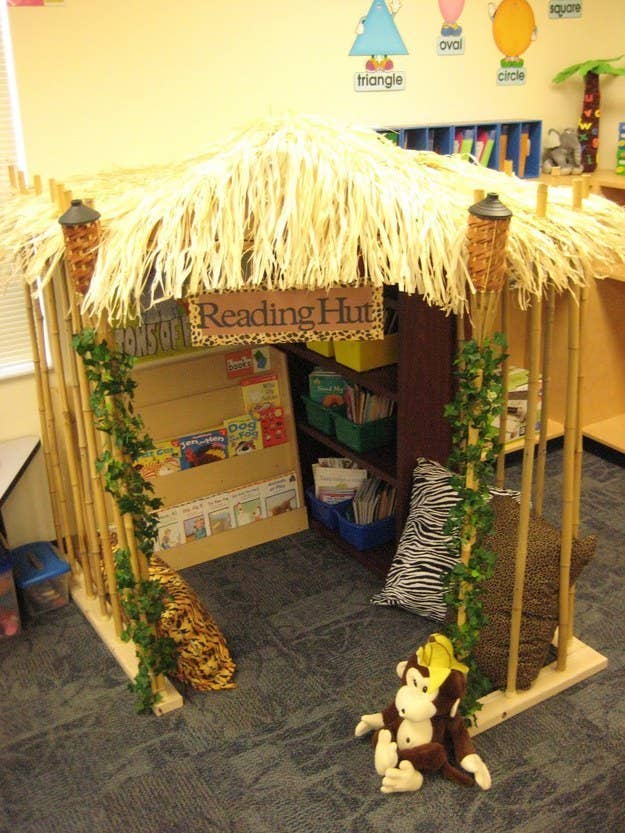
My classroom will have a fun, exciting reading area for my students. Because I want to encourage literacy, the reading nook will be one of their rotations throughout the day as we move through lessons and activities. I chose the "Reading Hut" because I want to have a jungle theme in my classroom.
I changed the reading area to be more open and accessible. I did this to make it more wheelchair friendly for any students with disabilities. This picture is not the best example, but I would most likely not have the jungle theme anymore. I want my students to really feel that they can create a classroom culture together instead of me imposing my culture on them. This picture demonstrates more of the layout rather than the decor that I would like to have in my classroom.
I will also make sure that I include many different books that show diversity. I want my books to include examples of as many different backgrounds- culturally, racially, ethnically, familial, and otherwise - as I can. I want my students to be able to learn about diversity, see it normal, and recognize themselves in the books I have available to them. I want my students to learn not to be prejudiced. Providing books about diversity or that include diversity is a way to teach social justice and fight oppression.
I do not want my student's desks arranged in a lecture format. I like the idea of them being able to easily talk to and collaborate with each other as they work on assignments and explore their new learning.
I will keep my desks arranged like this to facilitate conversations and students taking an active role in the learning process. I will assign students to seats at the beginning of the year according to their prior knowledge in subjects, making sure that students are spread throughout the room to help one another learn. Throughout the year, I will change their groups at the tables so they have as many experiences to work with a diverse population of peers as possible. I will need to make sure that the desks have enough room for a wheelchair.
Whenever I need to talk to my students, they will have a place to sit on this mat in the classroom. Any kind of lecturing or unified classroom lesson will be taught in this format.
I would like to keep floor time because I think it is efficient and fun. I will have the students sit in alphabetical order. If a student has a disability, I will make sure that there is a place for them where they can comfortable maneuver to. I will also ask them what what they would like to do/where they would like to be in order to make sure that they are as comfortable and happy as possible.
I will have a bulletin board to display each student's most recent work. In keeping with the jungle theme, each monkey represents a student.
Some students may not like having their work displayed, or may want a certain assignment displayed instead of another assignment. Because of this, I will let my students have up to one assignment displayed at a time. They can choose what they want to have displayed and for how long. If a student does not want to display their work, I will not force them to. Additionally, I would remove the monkeys from the display board and instead have something that works with the theme my students help choose together.
I think it's important to be organized in the classroom. Not only will it help in my teaching, it will help the students to know where to find things and where their supplies will go after they clean up.
I would like to keep my organization system, but I would need to make sure I have labels in multiple languages for emerging bilinguals. In this way, their first language will be reinforced and they will not be as confused or discouraged trying to find something. I would like to have maybe a longer shelf rather than a tall shelf, in order for students with disabilities to be able to easily reach the containers.
2. Imagine the surrounding in your classroom. What does the room look like? What resources are available for students? How are the resources used during the lesson?
The room looks colorful and exciting while still being organized. The decorations will be more subtle than overwhelming, because they are not the main focus - learning is. The students' resources include me, books, signs around the classroom, class materials, handouts, and each other. For each lesson, I will have a table with resources specific to the task available to the students at any time. If they need further help, I encourage them to raise their hands or come to my desk so I can help them.
I would also like to put up a sign that says my classroom is a safe space for LGBTQ+ students. This will help them and their families feel more comfortable. Items in the classroom should be spaced out enough to allow students with disabilities to easily maneuver around the room. I want to have labels in multiple languages to help my emerging bilingual students to understand their resources and activities. I would also like to have pictures around the classroom that showcase diversity, especially the diversity present in my classroom. I found this idea from this website: http://www.teachingforchange.org/anti-bias-education-articles, which I think is a really good resource for me to have. I would also like to have resources available for diverse students. For example, a basket full of red pieces of paper for students who feel uncomfortable or offended. Students can take a piece of paper at any time, and this will let me know to speak with them and work with them to make the classroom a more equitable environment.
Many of my students might come from backgrounds where hand-raising is culturally normal, but many of them might not as well. Because of this I will allow students to ask for help in other ways. I think it would be fun to have a classroom lesson and discussion where we decide as a class how students will communicate a need or desire for help instead of just raising their hands or coming to find me.
3. Describe the students in your classroom. What are their backgrounds? What are their interests? What are they doing during the lesson?
Because I am teaching Kindergarten, the students will come from many different backgrounds and have differing levels of experience and therefore ability in certain tasks. While I would hope that they are all interested in learning what I have to teach them, I realize that not all of them are. They have many different interests, from animals to books to people to art and beyond. During the lesson, the students are working hard but also having an enjoyable time. They help each other and ask questions when they have them, but listen when it is time to do so. I want their learning to be a collaborative, social experience.
Students will work with others of various backgrounds. I would like to encourage students to get to know peers who come from different cultural, ethnic, and racial backgrounds. I would also like students with disabilities to be included in conversations and groups. I really would like their learning to be a social experience. I realize now that my students will come from more diverse backgrounds and experiences than I had originally thought, but each student will be welcomed regardless of their backgrounds, sexual orientations, familial situations, or gender identities.
4. Describe your classroom policies. What are your classroom rules? What is your discipline plan? What are your homework policies?
My classroom rules:
- Listen the first time
- Always be kind to others
- If you have a question for the teacher, raise your hand
- Share the materials
- Participate in every activity
I would add a very important rule to this list: Respect. It is partially included in being kind to others, but I think students need to learn how to respect differences and each other more explicitly. I would also remove the rule about raising their hands with questions, because of the potential cultural differences I explained earlier. I would also modify the rule about participating in every activity. Students might be unable to participate in activities due to religious or cultural beliefs and practices. Instead, I would like them to participate in every activity that they can. I would like to communicate with parents about appropriate activities for their children instead of forcing something upon the student.
My discipline plan:
- For minor classroom disruptions, I will start with a small warning - reminding the students of the rules. If the disruptions continue, I will have the student come talk to me briefly at the beginning of a classroom activity.
- For larger problems between students, I will have both students talk to me during a non-essential activity, but they will not be able to participate with the other students. (For example, they will sit by my desk reading a book or completing a quiet assignment while the other students have structured play time.) I will also use this discipline for continued disruptions. These situations may merit a note sent to parents.
- In extreme situations, I will involve parents and possibly school administration.
If students have larger discipline problems, I would like to speak with them about it before taking action. Students may be having a hard time following rules or be in conflict with another student for reasons related to their backgrounds/cultures. These are important for me to acknowledge and work out instead of punishing students for their beliefs or practices.
The wording of my discipline plan should also be changed - "guardian(s)" instead of "parents" would be more appropriate, to include students who might be living with someone who is not a parent, in a single-parent home, or who have multiple adults interested in their education.
This plan is more of a guideline, but I will make sure I am explicitly open to individual adaptation according to familial, student, or classroom needs. This will allow students with disabilities to have a personalized plan for discipline, and will also allow me to adapt my discipline according to the situation.
My homework policies:
- I do not think that students in Kindergarten should have large amounts of homework. Most homework assignments will consist of finishing work not completed in class, to be due the next day. I will send a weekly list of sight words home with students each Monday. The next Monday, they will need to return it signed by parents that they practiced for 10 minutes every day. If they forget to bring it, the student has until Wednesday to bring it in.
I also will assign time for reading practice and writing. I forgot to include those when I first completed this assignment. Additionally, I will make sure I have supplies for all of the students. Students will be allowed to take books of their choice from the classroom library, and I will include writing utensils in their homework packet. The place for a signature saying that the student has completed their assignment will be changed from "parents" to "guardian(s)" with enough room available for multiple people to sign if they wish.
Homework assignments can be adjusted according to student ability. I will adjust automatically based on any IEPs and work with students and guardian(s) for any other adjustments needed.
5. Describe a typical lesson you will teach in your classroom. What will you teach? What is the topic? Why did you choose this topic? How will you teach it? What is the main thing you want students to learn during this lesson?
For this lesson, I will teach how to read the letters of the alphabet. I chose this topic because knowing how to read individual letters is one of the first steps in learning how to read. Some students may already know these, but it is foundational. I cannot risk any student not knowing this moving forward. I will teach it through first using more of a lecture format followed by a game. The main thing that I want students to learn is the basic phonics of the alphabet.
I failed to consider emerging bilingual students when I thought of this lesson. Before teaching the students phonics in English, I should talk about the concept of language. I would need to help students understand the concept of using a language at school and that it doesn't make this language better than any other language. I would like to include examples of other alphabets and have students who know the alphabet of another language share it with the class before we work on the English alphabet. I should focus on helping emerging bilinguals translanguage rather than forcing them to only use English.
6. Imagine your work as a teacher during this lesson. What are you doing during the lesson?
During this lesson, I will first be at the front of the classroom teaching each letter of the alphabet. When it is time for the students to play their game, I will move throughout the classroom helping them as needed.
I would mainly keep my work the same during this section, with most of the changes coming in my teaching methods. I would like to invite more student participation when I am teaching them to read the letters. I can give them an example of words that have certain letters in them and then ask them to give me examples as well - this will help the students connect letters to words from their personal lives and cultures.
7. Imagine your students again, what are they doing during the lesson?
During the beginning part of this lesson, the students will be sitting on the mat, repeating sounds back to me. Later, they will be sitting at their desks working in pairs to sound out letters on flash cards.
Students should not be only repeating sounds back to me - that is what Paulo Freire called banking education. Rather, I will model the sounds and allow them to explore them more, like with understanding how to use them in words.
8. Imagine how you will assess your students' learning and achievement. How will you know they have learned?
I do not expect students to learn this all in one setting, so I will repeat the activity periodically. To assess their learning, I will give the class an assignment to do at a later date and then call each student individually to show me how well they do at the flash card phonics.
For other lessons, I may use similar techniques, or assess their learning through their writing or artwork about a particular subject.
I like the idea of having more informal assessments that will not put as much stress on the student. I would like to add that I give students multiple chances to pass something like phonics off to me and give personalized help if they need it. This will provide extra help for students who come from maybe more disadvantaged backgrounds in a school built for the more privileged white, middle class students.
Explanation:
Many of the changes I made were because I simply wasn't considering how diverse my classroom will really be and how to best teach in those situations. I know that what I have re-imagined is not perfect, but it is hopefully a step in the right direction. I want all of my students to have the best chance for success in the classroom and in life. I also want them to learn how to work with each other and respect diversity. A lot of the reason why I set my classroom up the way I did was to have the students interact. This will allow them to become more familiar with students from an array of backgrounds and realize that diversity is not only good, but helpful. I want them to think of each other as equals. I also want to provide enough support to marginalized students to make my classroom equitable.
Re-imagined
My Imagined Kindergarten Classroom
1. Five images (you can take them or they can come from the Internet [provide proper credit]). These images should reflect, in some way, what you imagine your classroom will look like once you are a teacher. Please annotate your images by providing a description of the image and how it relates to your future classroom.
 |
| https://www.buzzfeed.com/weareteachers/21-creative-and-clever-reading-spaces-for-the-clas-h0xt?utm_term=.ufZLN6809#.ewYLo9O3l |
 |
| http://eberhartsexplorers.blogspot.com/2013/08/classroom-digs.html |
I will also make sure that I include many different books that show diversity. I want my books to include examples of as many different backgrounds- culturally, racially, ethnically, familial, and otherwise - as I can. I want my students to be able to learn about diversity, see it normal, and recognize themselves in the books I have available to them. I want my students to learn not to be prejudiced. Providing books about diversity or that include diversity is a way to teach social justice and fight oppression.
 |
| http://tickledpinkmandy.blogspot.com/2011/08/back-to-school.html |
I will keep my desks arranged like this to facilitate conversations and students taking an active role in the learning process. I will assign students to seats at the beginning of the year according to their prior knowledge in subjects, making sure that students are spread throughout the room to help one another learn. Throughout the year, I will change their groups at the tables so they have as many experiences to work with a diverse population of peers as possible. I will need to make sure that the desks have enough room for a wheelchair.
 |
| https://i.pinimg.com/originals/ec/25/01/ec2501897f322eb882015c7b60a164fb.jpg |
I would like to keep floor time because I think it is efficient and fun. I will have the students sit in alphabetical order. If a student has a disability, I will make sure that there is a place for them where they can comfortable maneuver to. I will also ask them what what they would like to do/where they would like to be in order to make sure that they are as comfortable and happy as possible.
 |
| http://sharingkindergarten.com/working-on-room-so-grab-some-tips/ |
I will have a bulletin board to display each student's most recent work. In keeping with the jungle theme, each monkey represents a student.
Some students may not like having their work displayed, or may want a certain assignment displayed instead of another assignment. Because of this, I will let my students have up to one assignment displayed at a time. They can choose what they want to have displayed and for how long. If a student does not want to display their work, I will not force them to. Additionally, I would remove the monkeys from the display board and instead have something that works with the theme my students help choose together.
 |
| https://i.pinimg.com/originals/5e/e6/a8/5ee6a81de5b5890ccbe5a003c8ea01ab.jpg |
I would like to keep my organization system, but I would need to make sure I have labels in multiple languages for emerging bilinguals. In this way, their first language will be reinforced and they will not be as confused or discouraged trying to find something. I would like to have maybe a longer shelf rather than a tall shelf, in order for students with disabilities to be able to easily reach the containers.
2. Imagine the surrounding in your classroom. What does the room look like? What resources are available for students? How are the resources used during the lesson?
The room looks colorful and exciting while still being organized. The decorations will be more subtle than overwhelming, because they are not the main focus - learning is. The students' resources include me, books, signs around the classroom, class materials, handouts, and each other. For each lesson, I will have a table with resources specific to the task available to the students at any time. If they need further help, I encourage them to raise their hands or come to my desk so I can help them.
I would also like to put up a sign that says my classroom is a safe space for LGBTQ+ students. This will help them and their families feel more comfortable. Items in the classroom should be spaced out enough to allow students with disabilities to easily maneuver around the room. I want to have labels in multiple languages to help my emerging bilingual students to understand their resources and activities. I would also like to have pictures around the classroom that showcase diversity, especially the diversity present in my classroom. I found this idea from this website: http://www.teachingforchange.org/anti-bias-education-articles, which I think is a really good resource for me to have. I would also like to have resources available for diverse students. For example, a basket full of red pieces of paper for students who feel uncomfortable or offended. Students can take a piece of paper at any time, and this will let me know to speak with them and work with them to make the classroom a more equitable environment.
Many of my students might come from backgrounds where hand-raising is culturally normal, but many of them might not as well. Because of this I will allow students to ask for help in other ways. I think it would be fun to have a classroom lesson and discussion where we decide as a class how students will communicate a need or desire for help instead of just raising their hands or coming to find me.
3. Describe the students in your classroom. What are their backgrounds? What are their interests? What are they doing during the lesson?
Because I am teaching Kindergarten, the students will come from many different backgrounds and have differing levels of experience and therefore ability in certain tasks. While I would hope that they are all interested in learning what I have to teach them, I realize that not all of them are. They have many different interests, from animals to books to people to art and beyond. During the lesson, the students are working hard but also having an enjoyable time. They help each other and ask questions when they have them, but listen when it is time to do so. I want their learning to be a collaborative, social experience.
Students will work with others of various backgrounds. I would like to encourage students to get to know peers who come from different cultural, ethnic, and racial backgrounds. I would also like students with disabilities to be included in conversations and groups. I really would like their learning to be a social experience. I realize now that my students will come from more diverse backgrounds and experiences than I had originally thought, but each student will be welcomed regardless of their backgrounds, sexual orientations, familial situations, or gender identities.
4. Describe your classroom policies. What are your classroom rules? What is your discipline plan? What are your homework policies?
My classroom rules:
- Listen the first time
- Always be kind to others
- If you have a question for the teacher, raise your hand
- Share the materials
- Participate in every activity
I would add a very important rule to this list: Respect. It is partially included in being kind to others, but I think students need to learn how to respect differences and each other more explicitly. I would also remove the rule about raising their hands with questions, because of the potential cultural differences I explained earlier. I would also modify the rule about participating in every activity. Students might be unable to participate in activities due to religious or cultural beliefs and practices. Instead, I would like them to participate in every activity that they can. I would like to communicate with parents about appropriate activities for their children instead of forcing something upon the student.
My discipline plan:
- For minor classroom disruptions, I will start with a small warning - reminding the students of the rules. If the disruptions continue, I will have the student come talk to me briefly at the beginning of a classroom activity.
- For larger problems between students, I will have both students talk to me during a non-essential activity, but they will not be able to participate with the other students. (For example, they will sit by my desk reading a book or completing a quiet assignment while the other students have structured play time.) I will also use this discipline for continued disruptions. These situations may merit a note sent to parents.
- In extreme situations, I will involve parents and possibly school administration.
If students have larger discipline problems, I would like to speak with them about it before taking action. Students may be having a hard time following rules or be in conflict with another student for reasons related to their backgrounds/cultures. These are important for me to acknowledge and work out instead of punishing students for their beliefs or practices.
The wording of my discipline plan should also be changed - "guardian(s)" instead of "parents" would be more appropriate, to include students who might be living with someone who is not a parent, in a single-parent home, or who have multiple adults interested in their education.
This plan is more of a guideline, but I will make sure I am explicitly open to individual adaptation according to familial, student, or classroom needs. This will allow students with disabilities to have a personalized plan for discipline, and will also allow me to adapt my discipline according to the situation.
My homework policies:
- I do not think that students in Kindergarten should have large amounts of homework. Most homework assignments will consist of finishing work not completed in class, to be due the next day. I will send a weekly list of sight words home with students each Monday. The next Monday, they will need to return it signed by parents that they practiced for 10 minutes every day. If they forget to bring it, the student has until Wednesday to bring it in.
I also will assign time for reading practice and writing. I forgot to include those when I first completed this assignment. Additionally, I will make sure I have supplies for all of the students. Students will be allowed to take books of their choice from the classroom library, and I will include writing utensils in their homework packet. The place for a signature saying that the student has completed their assignment will be changed from "parents" to "guardian(s)" with enough room available for multiple people to sign if they wish.
Homework assignments can be adjusted according to student ability. I will adjust automatically based on any IEPs and work with students and guardian(s) for any other adjustments needed.
5. Describe a typical lesson you will teach in your classroom. What will you teach? What is the topic? Why did you choose this topic? How will you teach it? What is the main thing you want students to learn during this lesson?
For this lesson, I will teach how to read the letters of the alphabet. I chose this topic because knowing how to read individual letters is one of the first steps in learning how to read. Some students may already know these, but it is foundational. I cannot risk any student not knowing this moving forward. I will teach it through first using more of a lecture format followed by a game. The main thing that I want students to learn is the basic phonics of the alphabet.
I failed to consider emerging bilingual students when I thought of this lesson. Before teaching the students phonics in English, I should talk about the concept of language. I would need to help students understand the concept of using a language at school and that it doesn't make this language better than any other language. I would like to include examples of other alphabets and have students who know the alphabet of another language share it with the class before we work on the English alphabet. I should focus on helping emerging bilinguals translanguage rather than forcing them to only use English.
6. Imagine your work as a teacher during this lesson. What are you doing during the lesson?
During this lesson, I will first be at the front of the classroom teaching each letter of the alphabet. When it is time for the students to play their game, I will move throughout the classroom helping them as needed.
I would mainly keep my work the same during this section, with most of the changes coming in my teaching methods. I would like to invite more student participation when I am teaching them to read the letters. I can give them an example of words that have certain letters in them and then ask them to give me examples as well - this will help the students connect letters to words from their personal lives and cultures.
7. Imagine your students again, what are they doing during the lesson?
During the beginning part of this lesson, the students will be sitting on the mat, repeating sounds back to me. Later, they will be sitting at their desks working in pairs to sound out letters on flash cards.
Students should not be only repeating sounds back to me - that is what Paulo Freire called banking education. Rather, I will model the sounds and allow them to explore them more, like with understanding how to use them in words.
8. Imagine how you will assess your students' learning and achievement. How will you know they have learned?
I do not expect students to learn this all in one setting, so I will repeat the activity periodically. To assess their learning, I will give the class an assignment to do at a later date and then call each student individually to show me how well they do at the flash card phonics.
For other lessons, I may use similar techniques, or assess their learning through their writing or artwork about a particular subject.
I like the idea of having more informal assessments that will not put as much stress on the student. I would like to add that I give students multiple chances to pass something like phonics off to me and give personalized help if they need it. This will provide extra help for students who come from maybe more disadvantaged backgrounds in a school built for the more privileged white, middle class students.
Explanation:
Many of the changes I made were because I simply wasn't considering how diverse my classroom will really be and how to best teach in those situations. I know that what I have re-imagined is not perfect, but it is hopefully a step in the right direction. I want all of my students to have the best chance for success in the classroom and in life. I also want them to learn how to work with each other and respect diversity. A lot of the reason why I set my classroom up the way I did was to have the students interact. This will allow them to become more familiar with students from an array of backgrounds and realize that diversity is not only good, but helpful. I want them to think of each other as equals. I also want to provide enough support to marginalized students to make my classroom equitable.
Friday, December 8, 2017
Portfolio VI: Book Club
I read the book Holler if You Hear Me: The Education of a Teacher and His Students by Gregory Michie.
Major Points of Disruption
This book challenged a lot of my ways of thinking about education and schools, especially in areas with low-income, marginalized students. Beyond that, it also challenged my ideas about society and the prejudices, stereotypes, and racism we have at structural and institutional levels.
One major disruption that I had occurred throughout the book and was stated very well during the introduction. It says, "The popular notion of what it's like to teach in urban America is dominated by two extremes. On one hand are the horror stories, fueled by media reports that portray schools in chaos: incompetent administrators, hallways that are more dangerous than alleyways, students who lack even the most basic skills, parents who are uneducated and unconcerned. On the other hand is the occasional account of the miracle worker, that amazing super-teacher/savior who takes a ragtag group of city kids and turns their lives around overnight. Somewhere in between these two, between the miracles and the metal detectors, is where I teach," (Michie, 1999, p. xxi). As I read the book, I kept expecting the stories Michie told of his students to end at one of those extremes. When they didn't, I was consistently surprised and had to really think about my beliefs and ideas. I think that we oftentimes put students into categories based upon stereotypes and don't really see them for who they are - to us, and to me, they are often just a statistic or a story instead of a person or a life. I kept wanting the students to become hugely successful and inspirational stories, and it bothered me when they didn't. Thinking of marginalized individuals as stories dehumanized them and allows us to avoid empathizing or at least sympathizing with them. It creates an environment for us to have a deficit theory perspective because we don't acknowledge their humanity, potential, and accomplishments.
A specific example of this from the book was the experience of a student named Tavares. When they held their mock court in the first chapter, he did an amazing job as the prosecutor. I thought for sure that when he told Michie his life story in the next section that he would have graduated from high school, gone on to college, and been studying in law school. In my head, that would have made it a good story. However, when I read that he had dropped out of school and become involved in gangs and drug dealing, I was shocked. I had seen this student's potential in the classroom and when he was talking about himself, and he hadn't reached it. I realized then that I had an idea in my head of how he should be living his life based on my standards of morality and my middle-class, white experience. I judge others based on my perspective, because it lets me feel morally strong and right. This, again, leads to a deficit ideology. What Tavares said really hit me, "A lot of times when a person does something wrong, they know it's wrong, but they do it anyway. It's like a person that gangbangs - he knows it's wrong, he knows shootin' people is wrong, he knows selling poison to his people is wrong. But all people see is the outer part - his pants hangin' off his butt and his hat turned this way or that way - but they never look within him to see what's making him do what he does. If a person was to sincerely look within these guys, they would find a lot of scared young people. Scared of being broke. Scared of not having. Scared of not being able to do for their parents or their kids. And some of 'em, including myself, come from a background where there wasn't a lot of love there. Living in a house with a single parent - she's trying to be the mom and the dad - it doesn't really work out. She knows she's all by herself, and whatever we get, it's gotta come from her. If it doesn't come from her, we won't have it. So having to live with that, it tends to build a lot of pressure, and also causes you to make some mistakes in the process," (Michie, 1999, p. 15). When I dehumanize the people doing things that I think are wrong, I miss the chance to see them as they really are and to understand a wider view of what happens in society. This leads to more oppression and racism against Latin Americans.
Another disruption I had while reading was about the welfare system. In general, I do not agree with or support the way the federal government has structured its welfare system, on either side of the political spectrum, but I generally disagree with expanding welfare more than I would agree with it. While one of the students, Ruby, talks about her life, she discusses welfare from a different perspective than I have. She says, "That stuff about cutting welfare pisses me off. I think every kid should have a medical card to help with the hospital bills and stuff. It's gonna affect the women the most, because a man can have as many kids as he wants, but he doesn't have to support them. He can just leave. Some women work two jobs to try and support their kids, to put food on the table, to buy diapers - it's hard. They should put more pressure on the men. It's like the man commits a crime, and the woman has to pay for it. It's like she had the kid by herself," (Michie, 1999, p. 122). In this conversation with Michie, Ruby brings up both feminist issues and welfare issues. Both are concepts that I have a harder time with. I definitely don't think it's okay that men abandon women and children to try and survive on their own, but I never really thought about how this would impact their need to governmental assistance. Because of their gender, women are stuck in poverty trying to care for children they love and want the best for, but they can't always provide. When I refuse to acknowledge that a larger welfare system could benefit these women and families who are working harder than I have ever had to because of my privilege, those of us who have privilege get to keep our financial and health security at the cost of theirs. While I still don't know how I feel about government welfare programs, I'm starting to see that there needs to be something in place for the working poor who still have an extremely difficult time trying to make ends meet.
There were two examples of interactions with the police that really stood out to me as I was reading. The first was talking about police presence in their neighborhood, or rather, the lack thereof. The students claimed that, while the gangs were the biggest problem in their community, the police were either scared of them or had given up on the areas with the heaviest gang influence (Michie, 1999, p. 136). This discussion challenged my thinking in two ways. First, the individuals living in those communities really know how dangerous it is and what the problems are. They don't like the violence or gangs, which I should have realized before, but the stereotypes I had heard and believed told me that everyone living there is the same. I realize now that this racism is so extremely wrong and that I need to fight against it in myself, as well as in those around me. Again, I have been allowing myself to dehumanize people in an effort to make myself feel more comfortable and at peace. When I believe this way, I contribute to a problem of people not reaching out to those areas because we think the people there don't deserve it for whatever reason. Second, I have always had a positive image of police and their ability to keep us safe. Children in elementary and middle school have realized that police have given up on their communities, which is just an awful thought. No one should have to live knowing that public servants only serve a specific portion of the population, and that they somehow don't qualify for protection or aid. It makes me feel gross inside. This leads to the other example involving the police. This one was even harder for me to read because it was police brutality. One of the students was attacked by a police officer while waiting for a bus to take him to a school basketball game, simply because he was African American in a Mexican American neighborhood. The police officer's partner allowed the brutality to happen, showing passive racism. I want to believe that police are good and helpful and unbiased, so reading about an instance of brutality is always hard for me, but this one was harder, because I have to acknowledge that it was completely unprovoked and just wrong. How can we allow this kind of thing to happen? The fact that it does happen, and probably more often than I have been willing to realize, tells me that there is definitely institutional and structural racism in our society. We allow our public servicemen to perpetuate racism and violence. This consistently oppresses people of all minoritized races and ethnicities. It upholds structures of power and privilege, and that's not okay. I was shocked and horrified when I read this account, in a chapter entitled "And Justice for Some", which shows the twisted and hypocritical nature of our society (Michie, 1999, p. 145-157).
Towards the end of the book, Michie describes a graduation ceremony for eighth grade students. Each student had to take a standardized test to graduate, and the description enraged me. Some students, who worked extremely hard, barely failed to pass these tests and were denied graduation from the eighth grade (Michie, 1999, p. 166). I have a lot of problems with standardized tests, but this is an example that just makes me furious. These tests, designed by people disconnected with students in schools, have the ability to determine an important step in their educations, and deny them of so many opportunities. Students who do not speak the language of power or have middle class, white experiences often perform worse on these tests and the tests themselves can be very dysfunctional. I don't think we should ever determine a student's future based on one standardized test, no matter their socioeconomic status, race, ethnicity, or any other factor from their lives. But forcing students who come from a place of lower opportunity, cultural capital, and privilege to fail based on this standard is simply awful. I couldn't believe it when I read that. It's so wrong.
Connections to Class
This book brought up a lot of points about equity versus equality. For example, the students lived in a community where the closest schools were low-quality and strict. While they had access to a public school, this school did not have very many resources to really meet their needs. Many of the teachers were stuck in a place of doubting the students, harshness, and burn-out. Another example is in the services available to them. They had landlords, police officers, and utility workers, but this was not enough to provide them with a safe environment and usable goods. The people in this community needed more to get onto a level playing field.
Students also dealt with many issues of race, ethnicity, and class. One student, Paloma, discussed the issue of social reproduction. She said, "People say it's a chain - like statistics just repeat themselves. They say that because you grew up in a certain neighborhood you're gonna be a certain way. Or since your parents did this or that, and since you're their son or daughter, you're gonna do the same thing. It's a chain that keeps on going and going and going. But I think it doesn't have to be that way. You don't have to be just another statistic. You don't have to be a part of someone else's chain. You can start your own chain - a good one, you know? But you can't do it by just complaining and sitting there doing nothing. If that's all you do, then whether you want it or not, you'll become a part of that statistic. You have to change your mentality," (Michie, 1999, p. 107). Paloma approached the topic of social reproduction from the perspective of grit ideology. However, as many students realized, they had been placed in a situation that was almost impossible to break the cycle of without a changing structure. Many of the students' stories talked about how they had dreams but circumstances prevented them from attaining them, just like Tavares, who I talked about earlier. Structural and institutional racism causes social reproduction, and denies the possibility of a meritocracy. Students also had to face the discrimination that came with self-identification. One student, Nancy, identified herself as "Mexican" and was corrected by a teacher, who said that Nancy was "Mexican-American" (Michie, 1999, p. 68). Because of power structures, being considered American, even part American, has been thought of as better by those in power. Having cultural capital allows people in positions of power to advance high enough in society to uphold the societal structure that favors whiteness. Nancy also provided an example of discrimination based on social class. In her college class, she did not feel that she fit in because she came from a lower class than the typical middle class college student. She had to work to speak up and be heard due to her background (Michie, 1999, p. 67).
The book also provides a lot of examples of deficit ideology. Students in Michie's first classes were pulled out from school for special help - not because they were not intelligent in reality, but because they were seen as not being intelligent or knowledgeable enough to succeed. Michie illustrates his frustration with deficit ideology, "I cringe at news reports and studies that suggest that all urban kids really need is to get back to basics. Because what often seems to accompany this idea is a belief that the basics are all poor black and Spanish-speaking children are capable of learning," (Michie, 1999, p. 103). Thinking that students cannot learn or think beyond the basics due to their background denies them of many opportunities for real growth. It upholds social and power structures and only benefits those in power.
I thought that Michie did a good job providing some examples of culturally responsive pedagogy. One thing he did that I really liked was bring in a book written by someone from a similar background to the students. The book, The House on Mango Street by Sandra Cisneros gave students the opportunity to study literature that they had the prior knowledge to really comprehend and relate to. In the case of reading The House on Mango Street, students had the correct language and experiences to really understand what the literature was saying. They enjoyed the experience and were able to learn a lot from reading, recording, and studying the book. They even had the opportunity to meet the author. She gave them an example of someone from their background, who really understood what it meant to live in their circumstances, who allowed it to shape her in good ways to influence others. Michie, in conjunction with another teacher, also had students study about what it means to be Mexican-American. In addition, he brought in culturally relevant media, topics, and ideas to the classroom in his Media Studies course.
Influencing My Future Work
Reading about the experiences of Gregory Michie and his students helped me realize a lot of things about teaching. Michie's most effective classes and lessons took place when he really related to his students and tried to include them in the learning process. He was not always successful. He talked about how he had a lot of bad days and there were students who he was not able to reach. I think that's something that's really hard to face as a teacher, but it's also something I think I need to come to terms with as I start my teaching. I can't let bad experiences prevent me from caring and from trying. Additionally, I need to work hard to prevent personal burn out and stress from impacting my students negatively.
Students can't learn in an environment where the teacher does not appreciate or include their cultures. They also deserve to have a teacher who is excited about the opportunity to interact with them. I want to teach Kindergarten, so I had hoped that my students would be more sheltered or protected from any harsh realities, but that won't necessarily be the case. Children in hard, inequitable circumstances are impacted by it very young, as evidenced by Michie's experiences in elementary school classrooms.
I cannot leave the work of supporting my students to someone else. Teaching for social justice includes me being a part of the change. I realized this as I read one specific story in the book. One student says, "Why does everybody say 'we' have to stop the gangs, 'we' have to stop the violence? You say that, but really you're waiting for another person to start up a resolution. You have to say, 'Oh, what can I do about this? What can I do?' So you could share it with another person, and that person could give you an idea, too. 'Cause you're always like, 'We should do something about this.' But you never do anything!" (Michie, 1999, p. 170). In order to effectively teach my children and include their cultures in my classroom, I have to be willing to change myself. I have to be willing to fight against the oppression I found reading this book, as well as other oppression in the world around me.
Reference
Michie, G. (1999). Holler if You Hear Me: The Education of a Teacher and His Students. New York, NY: Teachers College Press.
Major Points of Disruption
This book challenged a lot of my ways of thinking about education and schools, especially in areas with low-income, marginalized students. Beyond that, it also challenged my ideas about society and the prejudices, stereotypes, and racism we have at structural and institutional levels.
One major disruption that I had occurred throughout the book and was stated very well during the introduction. It says, "The popular notion of what it's like to teach in urban America is dominated by two extremes. On one hand are the horror stories, fueled by media reports that portray schools in chaos: incompetent administrators, hallways that are more dangerous than alleyways, students who lack even the most basic skills, parents who are uneducated and unconcerned. On the other hand is the occasional account of the miracle worker, that amazing super-teacher/savior who takes a ragtag group of city kids and turns their lives around overnight. Somewhere in between these two, between the miracles and the metal detectors, is where I teach," (Michie, 1999, p. xxi). As I read the book, I kept expecting the stories Michie told of his students to end at one of those extremes. When they didn't, I was consistently surprised and had to really think about my beliefs and ideas. I think that we oftentimes put students into categories based upon stereotypes and don't really see them for who they are - to us, and to me, they are often just a statistic or a story instead of a person or a life. I kept wanting the students to become hugely successful and inspirational stories, and it bothered me when they didn't. Thinking of marginalized individuals as stories dehumanized them and allows us to avoid empathizing or at least sympathizing with them. It creates an environment for us to have a deficit theory perspective because we don't acknowledge their humanity, potential, and accomplishments.
A specific example of this from the book was the experience of a student named Tavares. When they held their mock court in the first chapter, he did an amazing job as the prosecutor. I thought for sure that when he told Michie his life story in the next section that he would have graduated from high school, gone on to college, and been studying in law school. In my head, that would have made it a good story. However, when I read that he had dropped out of school and become involved in gangs and drug dealing, I was shocked. I had seen this student's potential in the classroom and when he was talking about himself, and he hadn't reached it. I realized then that I had an idea in my head of how he should be living his life based on my standards of morality and my middle-class, white experience. I judge others based on my perspective, because it lets me feel morally strong and right. This, again, leads to a deficit ideology. What Tavares said really hit me, "A lot of times when a person does something wrong, they know it's wrong, but they do it anyway. It's like a person that gangbangs - he knows it's wrong, he knows shootin' people is wrong, he knows selling poison to his people is wrong. But all people see is the outer part - his pants hangin' off his butt and his hat turned this way or that way - but they never look within him to see what's making him do what he does. If a person was to sincerely look within these guys, they would find a lot of scared young people. Scared of being broke. Scared of not having. Scared of not being able to do for their parents or their kids. And some of 'em, including myself, come from a background where there wasn't a lot of love there. Living in a house with a single parent - she's trying to be the mom and the dad - it doesn't really work out. She knows she's all by herself, and whatever we get, it's gotta come from her. If it doesn't come from her, we won't have it. So having to live with that, it tends to build a lot of pressure, and also causes you to make some mistakes in the process," (Michie, 1999, p. 15). When I dehumanize the people doing things that I think are wrong, I miss the chance to see them as they really are and to understand a wider view of what happens in society. This leads to more oppression and racism against Latin Americans.
Another disruption I had while reading was about the welfare system. In general, I do not agree with or support the way the federal government has structured its welfare system, on either side of the political spectrum, but I generally disagree with expanding welfare more than I would agree with it. While one of the students, Ruby, talks about her life, she discusses welfare from a different perspective than I have. She says, "That stuff about cutting welfare pisses me off. I think every kid should have a medical card to help with the hospital bills and stuff. It's gonna affect the women the most, because a man can have as many kids as he wants, but he doesn't have to support them. He can just leave. Some women work two jobs to try and support their kids, to put food on the table, to buy diapers - it's hard. They should put more pressure on the men. It's like the man commits a crime, and the woman has to pay for it. It's like she had the kid by herself," (Michie, 1999, p. 122). In this conversation with Michie, Ruby brings up both feminist issues and welfare issues. Both are concepts that I have a harder time with. I definitely don't think it's okay that men abandon women and children to try and survive on their own, but I never really thought about how this would impact their need to governmental assistance. Because of their gender, women are stuck in poverty trying to care for children they love and want the best for, but they can't always provide. When I refuse to acknowledge that a larger welfare system could benefit these women and families who are working harder than I have ever had to because of my privilege, those of us who have privilege get to keep our financial and health security at the cost of theirs. While I still don't know how I feel about government welfare programs, I'm starting to see that there needs to be something in place for the working poor who still have an extremely difficult time trying to make ends meet.
There were two examples of interactions with the police that really stood out to me as I was reading. The first was talking about police presence in their neighborhood, or rather, the lack thereof. The students claimed that, while the gangs were the biggest problem in their community, the police were either scared of them or had given up on the areas with the heaviest gang influence (Michie, 1999, p. 136). This discussion challenged my thinking in two ways. First, the individuals living in those communities really know how dangerous it is and what the problems are. They don't like the violence or gangs, which I should have realized before, but the stereotypes I had heard and believed told me that everyone living there is the same. I realize now that this racism is so extremely wrong and that I need to fight against it in myself, as well as in those around me. Again, I have been allowing myself to dehumanize people in an effort to make myself feel more comfortable and at peace. When I believe this way, I contribute to a problem of people not reaching out to those areas because we think the people there don't deserve it for whatever reason. Second, I have always had a positive image of police and their ability to keep us safe. Children in elementary and middle school have realized that police have given up on their communities, which is just an awful thought. No one should have to live knowing that public servants only serve a specific portion of the population, and that they somehow don't qualify for protection or aid. It makes me feel gross inside. This leads to the other example involving the police. This one was even harder for me to read because it was police brutality. One of the students was attacked by a police officer while waiting for a bus to take him to a school basketball game, simply because he was African American in a Mexican American neighborhood. The police officer's partner allowed the brutality to happen, showing passive racism. I want to believe that police are good and helpful and unbiased, so reading about an instance of brutality is always hard for me, but this one was harder, because I have to acknowledge that it was completely unprovoked and just wrong. How can we allow this kind of thing to happen? The fact that it does happen, and probably more often than I have been willing to realize, tells me that there is definitely institutional and structural racism in our society. We allow our public servicemen to perpetuate racism and violence. This consistently oppresses people of all minoritized races and ethnicities. It upholds structures of power and privilege, and that's not okay. I was shocked and horrified when I read this account, in a chapter entitled "And Justice for Some", which shows the twisted and hypocritical nature of our society (Michie, 1999, p. 145-157).
Towards the end of the book, Michie describes a graduation ceremony for eighth grade students. Each student had to take a standardized test to graduate, and the description enraged me. Some students, who worked extremely hard, barely failed to pass these tests and were denied graduation from the eighth grade (Michie, 1999, p. 166). I have a lot of problems with standardized tests, but this is an example that just makes me furious. These tests, designed by people disconnected with students in schools, have the ability to determine an important step in their educations, and deny them of so many opportunities. Students who do not speak the language of power or have middle class, white experiences often perform worse on these tests and the tests themselves can be very dysfunctional. I don't think we should ever determine a student's future based on one standardized test, no matter their socioeconomic status, race, ethnicity, or any other factor from their lives. But forcing students who come from a place of lower opportunity, cultural capital, and privilege to fail based on this standard is simply awful. I couldn't believe it when I read that. It's so wrong.
Connections to Class
This book brought up a lot of points about equity versus equality. For example, the students lived in a community where the closest schools were low-quality and strict. While they had access to a public school, this school did not have very many resources to really meet their needs. Many of the teachers were stuck in a place of doubting the students, harshness, and burn-out. Another example is in the services available to them. They had landlords, police officers, and utility workers, but this was not enough to provide them with a safe environment and usable goods. The people in this community needed more to get onto a level playing field.
Students also dealt with many issues of race, ethnicity, and class. One student, Paloma, discussed the issue of social reproduction. She said, "People say it's a chain - like statistics just repeat themselves. They say that because you grew up in a certain neighborhood you're gonna be a certain way. Or since your parents did this or that, and since you're their son or daughter, you're gonna do the same thing. It's a chain that keeps on going and going and going. But I think it doesn't have to be that way. You don't have to be just another statistic. You don't have to be a part of someone else's chain. You can start your own chain - a good one, you know? But you can't do it by just complaining and sitting there doing nothing. If that's all you do, then whether you want it or not, you'll become a part of that statistic. You have to change your mentality," (Michie, 1999, p. 107). Paloma approached the topic of social reproduction from the perspective of grit ideology. However, as many students realized, they had been placed in a situation that was almost impossible to break the cycle of without a changing structure. Many of the students' stories talked about how they had dreams but circumstances prevented them from attaining them, just like Tavares, who I talked about earlier. Structural and institutional racism causes social reproduction, and denies the possibility of a meritocracy. Students also had to face the discrimination that came with self-identification. One student, Nancy, identified herself as "Mexican" and was corrected by a teacher, who said that Nancy was "Mexican-American" (Michie, 1999, p. 68). Because of power structures, being considered American, even part American, has been thought of as better by those in power. Having cultural capital allows people in positions of power to advance high enough in society to uphold the societal structure that favors whiteness. Nancy also provided an example of discrimination based on social class. In her college class, she did not feel that she fit in because she came from a lower class than the typical middle class college student. She had to work to speak up and be heard due to her background (Michie, 1999, p. 67).
The book also provides a lot of examples of deficit ideology. Students in Michie's first classes were pulled out from school for special help - not because they were not intelligent in reality, but because they were seen as not being intelligent or knowledgeable enough to succeed. Michie illustrates his frustration with deficit ideology, "I cringe at news reports and studies that suggest that all urban kids really need is to get back to basics. Because what often seems to accompany this idea is a belief that the basics are all poor black and Spanish-speaking children are capable of learning," (Michie, 1999, p. 103). Thinking that students cannot learn or think beyond the basics due to their background denies them of many opportunities for real growth. It upholds social and power structures and only benefits those in power.
I thought that Michie did a good job providing some examples of culturally responsive pedagogy. One thing he did that I really liked was bring in a book written by someone from a similar background to the students. The book, The House on Mango Street by Sandra Cisneros gave students the opportunity to study literature that they had the prior knowledge to really comprehend and relate to. In the case of reading The House on Mango Street, students had the correct language and experiences to really understand what the literature was saying. They enjoyed the experience and were able to learn a lot from reading, recording, and studying the book. They even had the opportunity to meet the author. She gave them an example of someone from their background, who really understood what it meant to live in their circumstances, who allowed it to shape her in good ways to influence others. Michie, in conjunction with another teacher, also had students study about what it means to be Mexican-American. In addition, he brought in culturally relevant media, topics, and ideas to the classroom in his Media Studies course.
Influencing My Future Work
Reading about the experiences of Gregory Michie and his students helped me realize a lot of things about teaching. Michie's most effective classes and lessons took place when he really related to his students and tried to include them in the learning process. He was not always successful. He talked about how he had a lot of bad days and there were students who he was not able to reach. I think that's something that's really hard to face as a teacher, but it's also something I think I need to come to terms with as I start my teaching. I can't let bad experiences prevent me from caring and from trying. Additionally, I need to work hard to prevent personal burn out and stress from impacting my students negatively.
Students can't learn in an environment where the teacher does not appreciate or include their cultures. They also deserve to have a teacher who is excited about the opportunity to interact with them. I want to teach Kindergarten, so I had hoped that my students would be more sheltered or protected from any harsh realities, but that won't necessarily be the case. Children in hard, inequitable circumstances are impacted by it very young, as evidenced by Michie's experiences in elementary school classrooms.
I cannot leave the work of supporting my students to someone else. Teaching for social justice includes me being a part of the change. I realized this as I read one specific story in the book. One student says, "Why does everybody say 'we' have to stop the gangs, 'we' have to stop the violence? You say that, but really you're waiting for another person to start up a resolution. You have to say, 'Oh, what can I do about this? What can I do?' So you could share it with another person, and that person could give you an idea, too. 'Cause you're always like, 'We should do something about this.' But you never do anything!" (Michie, 1999, p. 170). In order to effectively teach my children and include their cultures in my classroom, I have to be willing to change myself. I have to be willing to fight against the oppression I found reading this book, as well as other oppression in the world around me.
Reference
Michie, G. (1999). Holler if You Hear Me: The Education of a Teacher and His Students. New York, NY: Teachers College Press.
Subscribe to:
Comments (Atom)